

Around 385,075 EVs were registered in the U.S. in the second quarter of 2025. These electric cars are gaining popularity due to their zero-emission logistics and sustainability goals.
But do you know that an EV requires special handling and care while shipping? Learn in this guide how EV car shipping services move your electric car safely across North America.
How Can I Ship My Electric Vehicle Across North America?
Shipping an EV across North America requires specific technical protocols. For instance, your electric car must maintain a State of Charge (SoC) between 20% and 50% to ensure the charge doesn’t drop to 0%, which can make the EV immovable.
Moreover, given that most EVs are 10-30% heavier than ICE vehicles, verify that your carrier uses reinforced ramps and soft-strap tie-downs to protect the chassis-mounted lithium-ion battery.
Also, for cross-border shipping, it’s essential that your vehicle is USMCA-compliant, especially now when recent 2025 Trump tariffs included a 25% blanket tax on vehicles from Mexico and Canada.
Lastly, use enclosed auto transport for luxury, high-value models to shield sensitive electronics from North American weather extremes.
Hiring a reputable car shipper like Easy Cargo Ship means outsourcing all the hassle to someone experienced. If you want help moving your EV, call (888) 687-3243 to get free electric car shipping quotes today!
How to Ship an Electric Car?
EV auto transport companies understand how electric car shipping is totally different from the standard car shipping process. And they follow all shipping protocols to ship an electric car safely across North America.
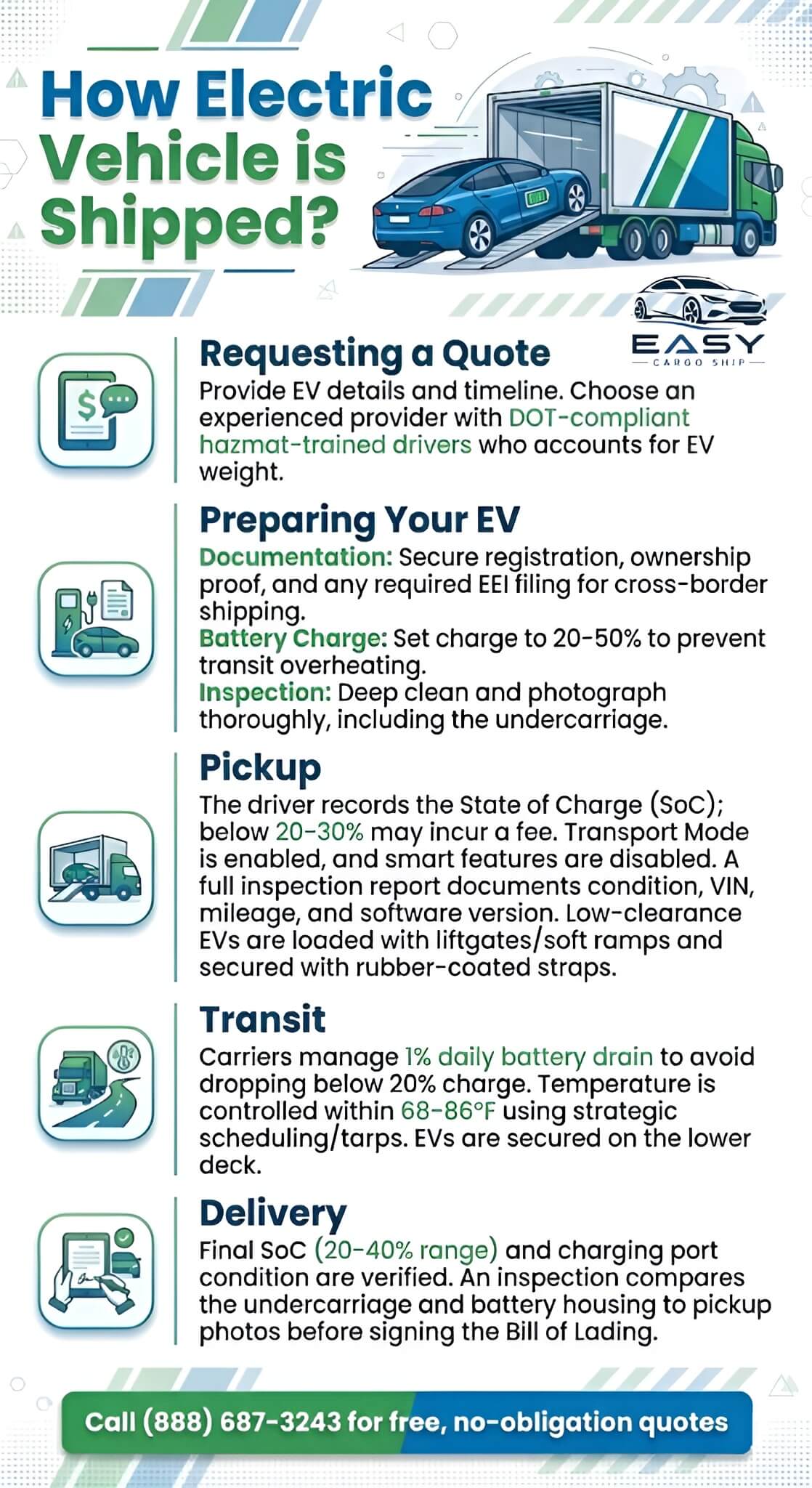
Here’s a step-by-step process of how an electric vehicle is shipped via EV transport services:
How to Request a Quote For Shipping An EV?
To request a quote from EV car shipping companies, provide them with details about your car, pick a transport method (open/enclosed car shipping), provide pickup and delivery addresses, and choose a shipping timeline.
However, keep in mind that electric car shipping is different from gas-powered car transport. And you must choose from EV auto transport companies that are highly experienced and well-equipped in moving electric cars like Easy Cargo Ship as we’ve moved all kinds of EVs from luxury sedans by Tesla, Lucid, and Rivian etc. to pickups like Ford F-150 lightening and so on.
Do not pick an EV transport company that offers a generic price, not accounting for the EV weight, or if the driver doesn’t have DOT-compliant hazmat training.
How To Prepare Your EV for Transport?
Next, prepare your electric car for the move.
Prepare Customs and Export Documentation:
When shipping across North America, custom paperwork and import/export forms are also required along with the regular documents such as your vehicle registration, proof of ownership/purchase, and a government-issued ID.
For instance, when shipping your EV from the U.S. to Canada, you will require an Electronic Export Information (EEI) filing through the U.S. Customs and Border Protection (CBP) Automated Export System (AES). It’s an export requirement, submitted electronically to CBP 72 hours before the vehicle can legally leave the U.S.
Check Your EV Battery’s SoC Level:
Your vehicle should only be charged to recommended levels. As per industry data, the sweet spot for battery charging level is 20-50%. Anything higher than this would overheat the battery during transit and could cause a fire.
For instance, recently, a case was reported where, during Tesla car shipping services, a car-carrier truck caught fire. Though the exact reason behind the incident was not revealed in the report, it depicts fire risk linked to EVs and lithium-ion batteries during transport.
Inspect and Document the Vehicle Condition:
Make sure to wash your car deeply and inspect its interior/exterior for prior damage. Take clear photos of the car from inside and out, and don’t miss the undercarriage. It is very important for insurance claims later if any damage occurs during transport.
Remove Accessories:
Remove all aftermarket accessories including the toll tags and portable chargers.
What Happens When EV is Being Picked Up For Transport?
Whether you choose door-to-door shipping or terminal-to-terminal service, pickup logistics in both of these services are as follows:
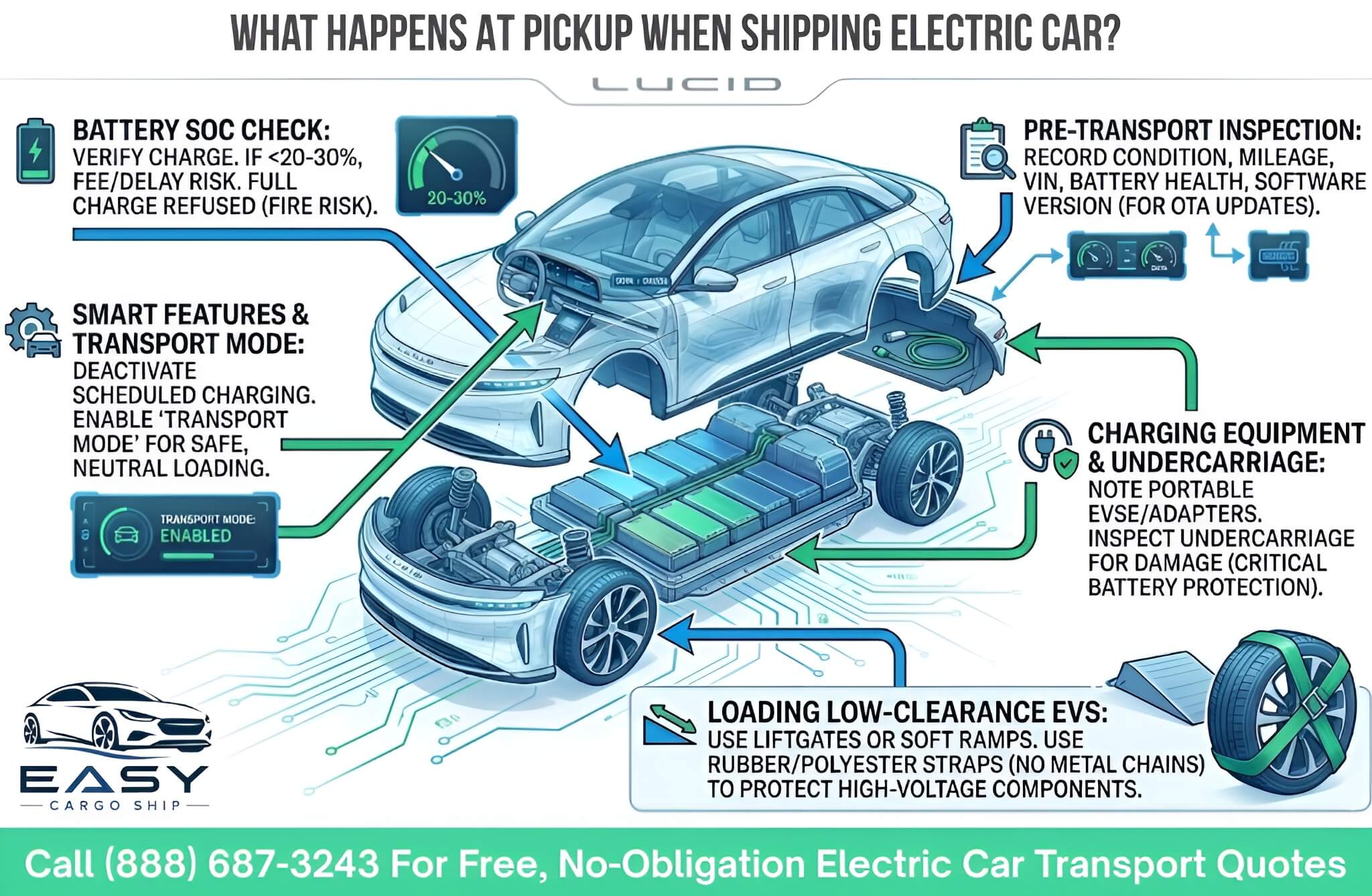
Battery State of Charge (SoC) Verification:
A driver or representative from the EV car shipping company might verify the State of Charge (SOC) through onboard diagnostics or dashboard display and record the exact percentage during pickup. If it’s below 20-30%, a non-runner fee might be charged, or a delayed pickup might be scheduled for further charging. Moreover, in case the battery is fully charged, a carrier might refuse to pick up due to fire risk.
Disabling Smart Features and Transport Mode:
Next, the driver will deactivate all smart features of your EV before loading the car. For instance, he will disable scheduled charging and engage ‘Transport Mode’ if your EV supports it. This mode will allow free-rolling for positioning and put your car in neutral without engaging park. Many EV Brands support this mode including Tesla, Ford, and Rivian.
Pre-Transport Inspection Report:
Then, the driver will create an inspection report, recording the overall condition of the vehicle, mileage, VIN number, and battery health. The current software version is also recorded on the report. This is to avoid responsibility disputes later, if your EV receives over-the-air (OTA) updates automatically, even while in transit, and then shows a system error later.
Documentation of Charging Equipment and Undercarriage Inspection:
Also, he will document if portable Electric Vehicle Supply Equipment (EVSE) is in the car or if charging adapters are present. Lastly and most importantly, the undercarriage of your EV will be inspected for any visible dents, cracks, and punctures. This is very important in electric car shipping because the battery is placed low in the middle of the car, and recording any pre-existing damage is essential to avoid liability disputes.
Loading Method for Low-Clearance EVs:
Carriers use liftgates or soft-ramp loading for low clearance EVs, like Lucid Air. Also, they use rubber-coated or polyester straps instead of metal chains to prevent accidental contact with high-voltage components.
What Happens During Electric Car Transit?
Since most EVs drain at least 1% per day, carriers ensure there’s no potential delay in your car’s delivery and it reaches in time before the battery percentage drops to 0%. Otherwise, the car won’t be able to move under its own power, doors may not unlock, and immediate charging is required before delivery.
And since temperature plays a major role in battery degradation, carriers use several temperature control strategies to minimize the damage.
For instance, the optimal temperature range for batteries that power electric vehicles is 20 to 30 °C (68 to 86 degrees Fahrenheit). So if they’re shipping from Canada towards Texas or Arizona, an enclosed carrier makes much more sense.
Also, electric vehicle transport services ensure the charging port is secured during transit, either with the weatherproof tape or a port cover. Lastly, they will transport your electric vehicle on the lower deck to keep the car stable and to reduce side-to-side movement.
How to Receive Your EV At Delivery?
In the final handing-off phase, your electric car is delivered to its location, and carriers ensure it doesn’t sit idle in storage for extended periods. Otherwise, the battery health and its long-term performance may be affected.
That’s why most electric vehicles arrive ready for delivery, and after the essential inspection protocols, you can drive them home. For instance, first of all, they verify the State of Charge (SoC), 20-50% is the acceptable range. Then, check if the charging port is intact and the charging cable and adapter are present (if you placed them in the trunk at pickup).
All of this, besides visual inspections, is documented in the form of pictures and videos, a manual functionality report, and fluid levels, which are documented on the Bill of Lading by electric vehicle transport services. And after you sign the Bill of Lading, you can take your vehicle home.
Note: Make sure the condition of the battery pack housing and skid plate at the time of delivery matches the pre-pickup condition.
Hiring a reputable car shipper like Easy Cargo Ship means outsourcing all the hassle to someone experienced. If you want help moving your EV, call (888) 687-3243 to get free electric car shipping quotes today!
How Much Does It Cost to Ship an Electric Car Safely?
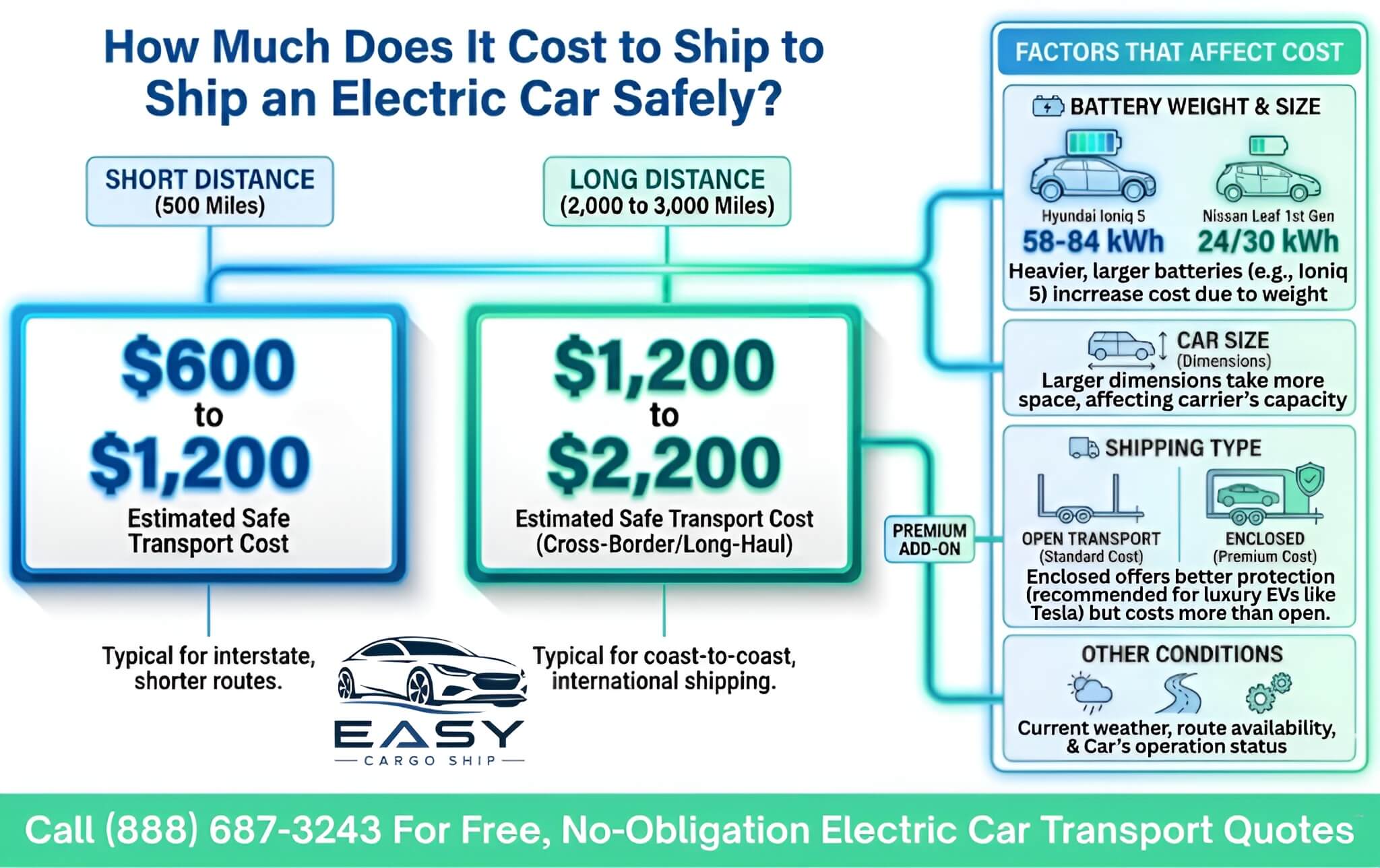
EV auto transport companies charge around $600 to $1,200 to ship an electric car safely over short distances (500 miles). But if you’re shipping an EV across the border, expect to pay around $1,200 to $2,200 for 2,000 to 3,000 miles. However, the price to ship may increase or decrease with battery weight, car size, and the distance.
For instance, the cost to ship a Hyundai Ioniq 5 (which has a large 58-84 kWh lithium-ion battery pack, depending on the trim) will be higher than shipping a Nissan Leaf first generation (24 or 30 kWh lithium-ion battery pack). Moreover, it also depends on whether you’ve chosen enclosed EV shipping or open car transport.
There’s a premium cost for enclosed trailer shipping with door-to-door service, but worth it for your Tesla car shipping services. Lastly, current weather conditions, route availability, and operational status of your car count as well.
What To Consider When Shipping Your EV Cross-Border?
Geographically North America includes Central America and the Caribbean as well. But for this guide, we’ve focused on the United States, Canada, and Mexico only, because shipping between these three countries is mostly land-based and they have the most established vehicle transport infrastructure.
Moreover, these three countries form the USMCA trade bloc (formerly NAFTA). So you get the USMCA trade agreement benefits as well. Plus, there’s high demand for EV shipping across the U.S., Canada, and Mexico. All thanks to the highest EV adoption rate, supported by mature charging infrastructure, OEM presence, and logistics specialization.
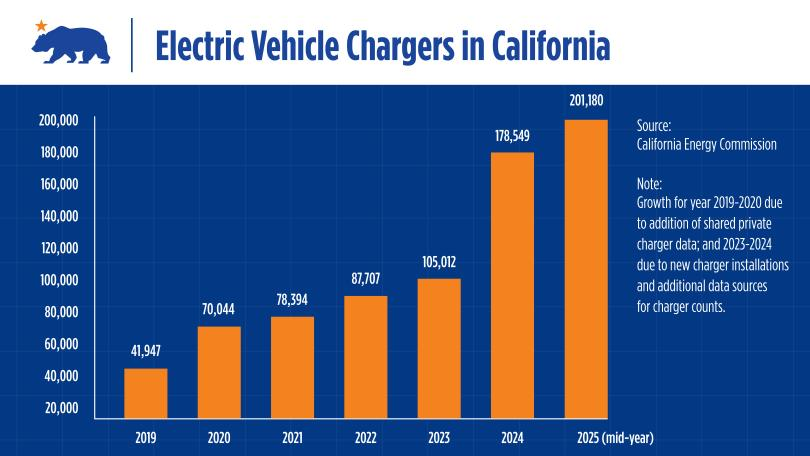
For instance, as of December 2025, the US has over 78,361 EV charging stations and 237,134 charging ports with California alone encompassing over 200,000 publicly accessible EV chargers, exceeding gasoline fueling infrastructure in the state.
However, we do offer international freight services for shipping your EVs to Central America and the Caribbean via RoRo.
But this service introduces additional port regulations and Hazmat protocols. That’s why, for this blog, we’re focusing on land-based shipping only, which is faster, more streamlined, and easier to coordinate.
USMCA Rules of Origin and Documentation Requirements
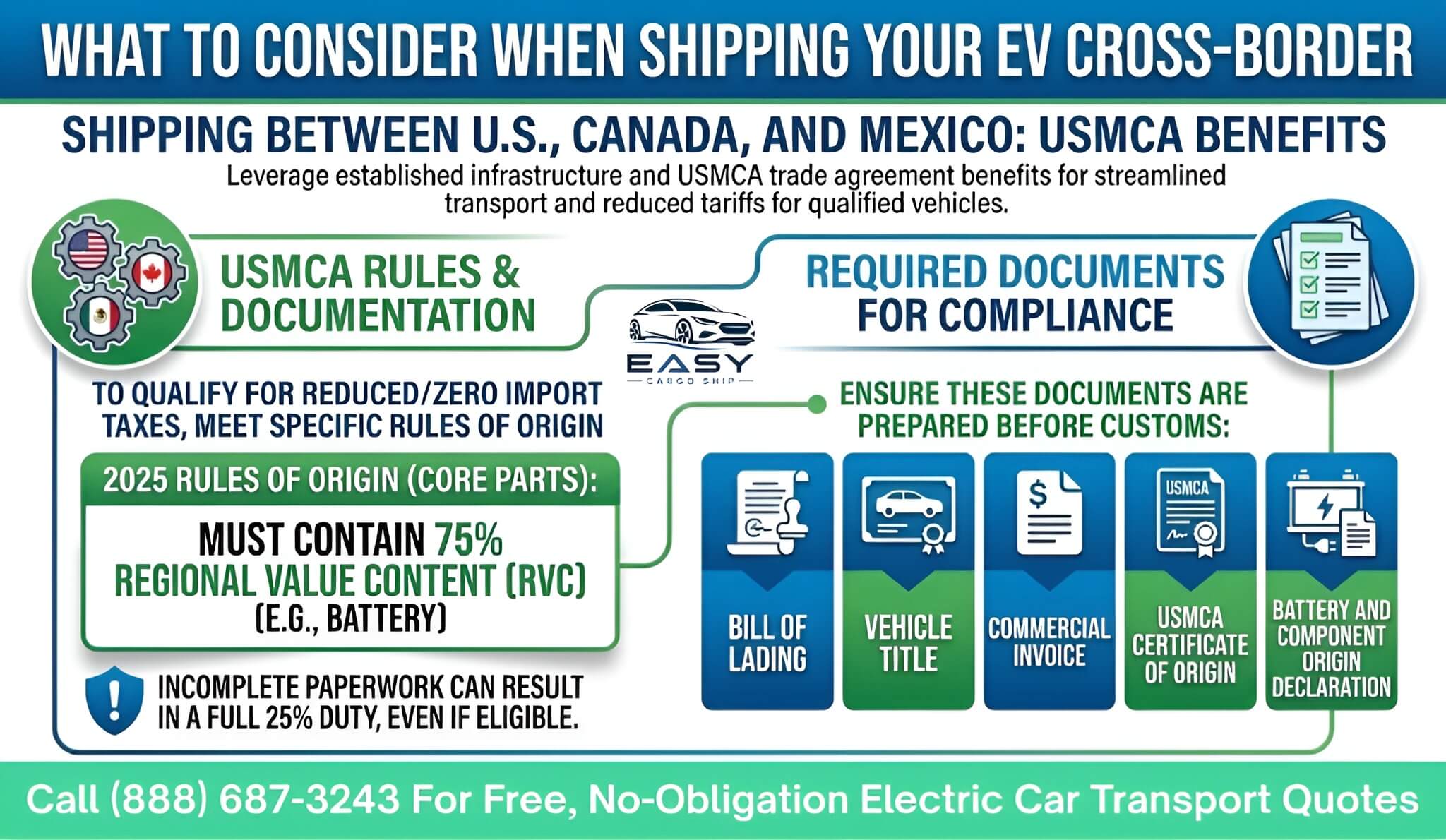
Under the USMCA Agreement, if most of a vehicle (including its major parts) is assembled in North America, you may qualify for reduced or zero import taxes. But for that, your vehicle needs to meet specific rules of origin and documentation requirements.
For instance, you must describe the vehicle in sufficient detail to enable its identification (fill this Certification of Origin), and ensure the major components of the vehicle (like the lithium-ion batteries) meet the origin requirements.
So, under 2025 USMCA rules, “Core Parts” (including EV batteries) must meet a 75% Regional Value Content (RVC) threshold.
But just in case you fail to submit complete and accurate customs paperwork, your vehicle might not qualify for preferential tariff treatment (even if eligible).
In addition to that, due to recent tariff changes in 2025, EV shipping across the U.S., Canada, and Mexico has become much more complex. Now with updated custom rules and new tariff changes, even USMCA-eligible vehicles must correctly prove their origin or customs may apply the full 25% duty.
That’s why you need professional cross-border EV shipping services to help ensure all the required documentation is prepared before your EV reaches customs.
What Documents are Needed for USMCA Tariff Compliance?
Roughly you need the following documents ready before the shipment reaches customs:
- Bill of Lading
- Vehicle Title
- Commercial Invoice
- USMCA Certificate of Origin
- Battery and Component Origin Declaration
What Questions You Should Ask Your EV Auto Transport Company Before Booking?
Before booking any electric vehicle transport service, ask a few important questions:
- How much experience do you have in EV transport specifically?
- What does the insurance policy cover? (Verify insurance limits).
- Does the coverage apply to both vehicles and their electric components?
- Do you offer enclosed shipping for electric cars?
- Can I track my car during transit?
- How much do you charge for non-operational electric vehicles or heavy battery loads?
Hiring a reputable car shipper like Easy Cargo Ship means outsourcing all the hassle to someone experienced. If you want help moving your EV, call (888) 687-3243 to get free electric car shipping quotes today!
Easy Cargo Ship Moves All Kinds of Electric Vehicles To and From North America:
You need specialized EV car shipping services to move your Tesla or any other zero-emission electric vehicle. The shipping procedure is different, complex, and it costs more as well, mostly due to the complexities involved, including more labor work required, and careful documentation to meet USMCA requirements.
Plus, the recent tariff changes have also made this process quite intricate. So, if you need professional Tesla car shipping services to handle this manifold process smoothly, call (888) 687-3243 to get free electric car shipping quotes today!
Frequently Asked Questions:
How are EV’s shipped?
The most common shipping method for EV transport is enclosed shipping. Though you can also ship your electric vehicle on an open trailer, enclosed shipping for electric cars is way safer and more reliable, especially for high-value cars like Tesla or Audi e-tron.
What is the best company to ship cars across the U.S.?
The best company to ship an electric car safely across the U.S. is the one that’s experienced in moving EVs and has enough liability insurance to cover your luxury electric car if it gets damaged during the moving process. And most importantly, it should be registered with FMCSA and have a good reputation among seasonal movers.
What is the average price to ship a car across the U.S.?
It costs around $600-$1,195 to ship a car in an open trailer across America. However, the charges may increase or decrease based on the weight/size of your car, distance, operational status of your car (whether it’s running or non-running), time of the year, and your pickup/delivery location.
Where do most EVs come from?
China is the biggest manufacturer of electric vehicles globally. With 2.6 million deliveries, BYD (a Chinese brand) leads the list of the world’s top EV makers, with Tesla being third (having 985,000 annual deliveries).
Do I need insurance when shipping a car?
Usually, you do not need to carry your own car insurance when shipping your car via a car hauling company. However, you may need to choose a car shipping service that offers adequate insurance for your car (in case an accident occurs during the moving process).